Exclusive: Twin Peaks Star Ray Wise On His ‘Life-Changing’ Run As Leland Palmer

Ray Wise, pictured as Leland with his Twin Peaks family, Grace Zabriskie’s Sarah and Sheryl Lee’s Laura (l.), and today.
On April 8, 1990, ABC introduced viewers to the twisty, fascinating and utterly unique dramatic universe of Twin Peaks, set in a Pacific Northwest town rich with secrets. Created by Mark Frost and David Lynch, the show kicked off with an enticing mystery — “Who killed Laura Palmer?” — that became a cultural phenomenon. On the 35th anniversary of Twin Peaks‘ debut, Soap Opera Digest checked in with Ray Wise (ex-Ian Ward, Young and Restless), who played Laura Palmer’s father — and (spoiler alert!) killer.
Soap Opera Digest: How did landing the role of Leland Palmer change the course of your career?
Ray Wise: Well, it was instrumental. I mean, it was life-changing for me, as a human being and as an actor. The opportunity that David and Mark gave me to play Leland was, certainly, the high point of my career, and remains so to this day. It awakened in me so many things, so many feelings, and as an artist and as an actor, having the freedom and openness to express myself freely [is paramount]. During the course of that show, I ran the gamut of emotions and it really allowed me, for probably the first time in my career, to feel that freedom, to feel that I could do anything if I set my mind to it. Watching David work and working with him certainly inspired that in me. Working with David was not only the greatest working relationship, but we were close friends. His passing [in January 2025] was somewhat of a shock because we knew he wasn’t feeling that well, but he was, I believe, in fairly good spirits on the day that he passed. That day, and probably the next day too, I was a little numbed by it. It was a difficult thing to accept because he seemed to me to be someone who would live forever.
Digest: When you reflect on the cultural significance of Twin Peaks, and how much it endures in the hearts and minds of its audience, what does it mean to you that David Lynch and Mark Cross picked you to be Leland?
Wise: Oh, it means so much. When I think about the scope of it, it’s a little difficult to process. David had a facility to be able to cast the right person for the part. You know, I initially went in to meet with David, I thought that I was going up for the character of Sheriff Truman [who was played by Michael Ontkean]. They sent me the script and I read it and I thought, “I’m just right for the sheriff.” Several days after our meeting, I got a call saying they wanted me to play Leland Palmer. I had to go back to the script and read Leland again and I saw that he finds out his daughter is dead and he cries, and then he goes to the morgue to identify her body and he cries, and then he’s in her room while the police are searching around for her diary, and he cries again. I thought, “All this guy does is cry!” And then it dawned on me if I play this fellow, I have to show different levels of grief. And the complexity of the character dawned on me at that moment. I thought, “This is an opportunity to really extend myself and flesh out the different areas of my own psyche.” I looked at it as a real challenge, and somewhat daunting — and when I feel that daunting challenge, I’m raring to go! When I feel that there’s a possibility that I could fail at doing this, that’s what sparks me.
Digest: When you were filming the show, could you tell that it was something special? Obviously, before it was on the air, you didn’t know how it would look, how it would be edited, how it would be scored.
Wise: Yeah, we had no idea what the music was going to be like, with Angelo Badalamenti as the composer, and we didn’t know how beautifully Duwayne Dunham would edit it, we didn’t know what the photography would look like. We knew that we were doing something special on a day to day basis, working with David on that pilot, but we didn’t know how would it would be viewed by a television audience or by the network or any of those things. We knew that we were secure in the work, but we had no idea of what the result would be. And then when the pilot aired, all hell broke loose! We knew that we were doing something very special and we kept the ball rolling. We had a series of directors — David directed four or five episodes, I believe, and we had other movie directors, like Tim Hunter and Graeme Clifford and Caleb Deschanel, coming in to direct episodes, but it didn’t really matter who the director was that much because we were on a roll and we knew what we were doing. And it was sort of that way all the way to the end, at least as far as my participation goes. I was gone by the 15th episode, I think.
Digest: Which made me so sad, by the way!
Wise: You know, David never wanted to have to solve the murder mystery. He wanted to keep it going forever. It was the network that wanted to put an end to it. They weren’t really enamored of the show that much; they weren’t behind it 100 percent. So, they made their demands and finally, David and Mark Frost had to succumb to them. They threatened to cancel the show [unless the killer was identified] — I think so, anyway. I can’t say for certain, but I think they put the strong arm on them, and that’s what happened.
Digest: What do you recall about your reaction to finding out that Leland was the killer?
Wise: Oh, my God — it was earth-shaking! It was anathema to me to find out that my character was the killer of his own daughter. I certainly didn’t want it to be me. I wanted it to be anybody else in town, anyone but me! I thought Ben Horne would have been a good one. For a couple of days, I said, “I don’t know. I don’t know that I can do this.” I had a little daughter at the time. She was a couple of years old, my daughter, and that whole idea was just…. It just didn’t lay right on me. But then we sat down in a dark room — me, David, Mark Frost, Richard Beamer, who played Ben Horne, and Sheryl Lee, who played Laura, but she was playing her cousin Maddie at the time. We were sitting down on the floor. I believe there was a lava lamp in one corner of the room, and that was the only light in the room and David leaned over and he touched my knee and he said, “Ray, it’s you. It’s always you.” And I thought, “Oh God, no.” And then he went on to explain my demise, my death scene, and how I would die in the arms of Agent Cooper and he would be reciting the Tibetan Book of the Dead and I would look down a long, bright tunnel and at the end of it was this searing white light and in that white light would be my daughter, Laura, and she would be holding out her arms to me and forgiving me. He painted such a picture for me in that room that, as David would say, in my mind, it became a beautiful thing. A beautiful thing. And that took the onus off it for me completely.
The show was so beautifully written, and it was so complex and and it was operating on several different levels all at once. And then to have the master, David, behind all of it — it was just a beautiful, beautiful, situation. We were so joyful coming to work every morning, because we knew we were going to be doing something beautiful and exciting. I’d never had a work experience like that prior to that, and not very many after that that came even close to it. For me, it was a high point in my career.
Digest: Especially for a show that had a relatively short life, running only two seasons, its impact is pretty incredible.
Wise: Twin Peaks, in the short time that it was on, it burned brightly and it opened the door for so many other shows that followed in later years. Even today, you’ll see a review of a new show on one of the networks or streaming services and and they’ll make a reference to Twin Peaks, that it’s Twin Peaks-ian or it’s very Lynchian. I think it had a tremendous impact on our culture.
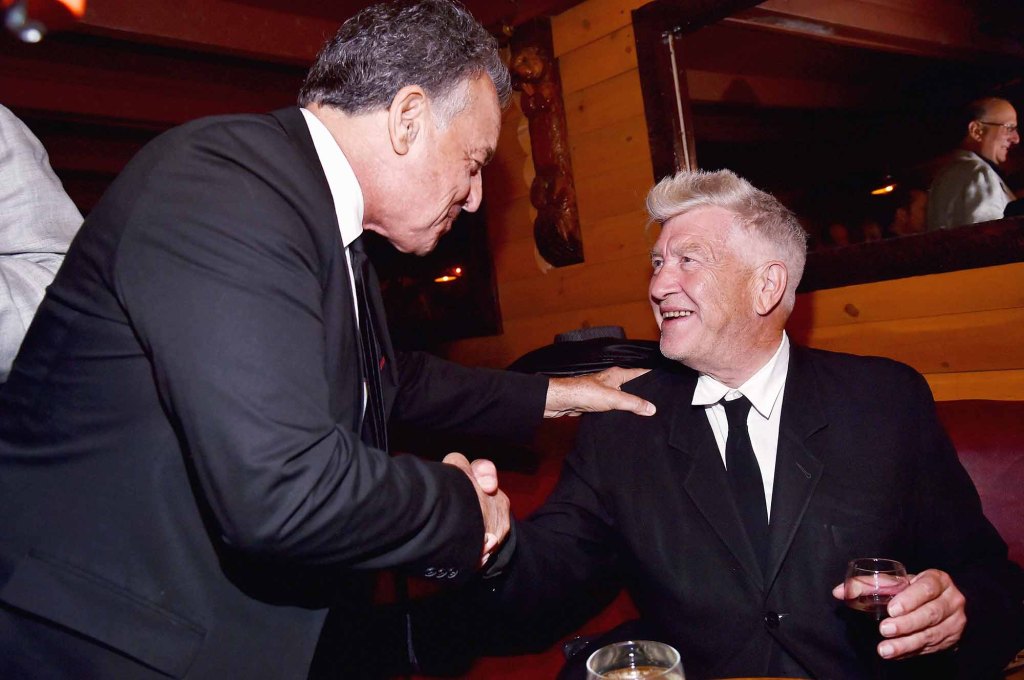
Wise Guy: The actor with Twin Peaks‘s visionary co-creator and director, the late David Lynch, who also appeared in the series as FBI Deputy Director Gordon Cole.







Conversation
All comments are subject to our Community Guidelines. Soap Opera Digest does not endorse the opinions and views shared by our readers in our comment sections. Our comments section is a place where readers can engage in healthy, productive, lively, and respectful discussions. Offensive language, hate speech, personal attacks, and/or defamatory statements are not permitted. Advertising or spam is also prohibited.